MEd
Module - Research Strategies 1
Proposal for a Faith Education Research Project
Introduction
The motivation for my proposed
research comes from my personal background over the last
twenty years. Considerable experience of interfaith dialogue
in that time has placed me in a position to discuss and assess
a wide range of views and perceptions of education held by
members of the established and minority churches, as well as
followers of those world faiths usually approached under the
umbrella of ethnicity in this country. In particular, I have
long been involved with the muslim community specifically in
the fields of muslim education and the education of muslims.
General Area of Interest
To a certain extent I am interested
in Religious Studies as they are currently accepted within the
curriculum, but also, perhaps more importantly, I have a
concern for religion, morality and faith identity as they
relate to PSE/PSD, and affect pupil relationships within
school, as well as familial and social relationships outside
school. I am also committed to finding practical means of
facilitating teachers' abilities to satisfy parental
requirements with regard to their children's education, and to
provide "Education for All" to at least the
standards suggested by the Swann Report "preparing all
pupils for life in a society which is both multi-racial and
culturally diverse". (DES, 1985, p. vii)
The Problem
"...action research is situational
- it is concerned with diagnosing a problem in a specific
context and attempting to solve it in that context; .....
According to Blum, the use of action research in the social
sciences can be resolved into two stages: a diagnostic
stage in which the problems are analysed and the
hypotheses developed; and a therapeutic
stage in which the hypotheses are tested by a consciously
directed change experiment, preferably in a social life
situation. As far as educational contexts are concerned,
however, Stenhouse is careful to stress that action research
should contribute not only to practice but to `a theory of
education and teaching which is accessible to other
teachers'." (Cohen & Manion, 1980, p. 208)
My
proposed research involves two problems:
a) the disadvantage to minority opinions and traditions
(in this case, those of faith communities) when facing
homogenising societal structures;
b) the problem of finding a means of dealing with this
disadvantage in the education system, itself one of those
structures.
If
we are to deal with the latter, it is necessary to be sure
that the former is indeed a problem and not a mirage. I will
therefore consider faith, values, and their educational
implications in general before looking at the specific
proposed area of research. After all, if we are to formulate a
relevant therapy, we must be sure of the bases of our
diagnosis.
Moral & Religious Education
"The socialization of the
student as a moral being has been a core concern of mass
education since its rise in the eighteenth and nineteenth
centuries. There is no period or place in which education is
conceived to be a narrowly technical enterprise, involving
knowledge and competence in language or mathematics
independent of broader socialization into the moral
order." (Cummings et al., 1988, p.12)
The educational pendulum has swung a
long way since Thomas Arnold stopped the teaching of science
at Rugby on the grounds that 'Physical science alone can never
make a man educated; even the formal sciences, valuable as
they are with respect to the discipline of reasoning power,
cannot instruct judgement; it is only moral and religious
knowledge which can accomplish this'. Very few (though some,
I'm sure) would hope for such extreme measures nowadays, but
many would agree wholeheartedly with his sentiments, and the
extent to which religion and values are now minimalised in the
curriculum is being challenged from many quarters.
"Periodically, critics assert a
weakening in the moral fabric of their societies. ......
Through the 1960s, this pessimism tended to be dismissed, at
least by national opinion leaders and prominent intellectuals,
as the reaction of out-of-phase moralists who were being
displaced by the progressive changes associated with the
transition to post-industrial society. ...... But over the
past decade the tide of opinion has shifted. .... Gallup polls
in the US indicate that parents are as concerned that schools
help students to develop standards of right and wrong as to
teach them to speak, think, write and count." (Cummings
et al., 1988, p.3)
In
Britain, the last few decades have brought about enormous
change in social and work patterns in the community, affecting
parent-child relationships, and profoundly altering the
balance between professional secular education and the home
educational environment usually accredited with primary
responsibility for moral and value system education.
In
our secular approach to education, those aspects of forming a
worldview which are generally considered to be of primary
importance within faith communities are marginalised.
Questions of morality, the nature of being, mankind's purpose
and the meaning of life, are given minimal curriculum time,
and the scriptural heritage, ritual forms, worship, culture
and way of life of specific religious traditions are given a
brief anthropological glance when they are not ignored
completely.
"Values education is possibly
the most fundamental concern of society, yet much of the task
of values education is carried out by the institutions of the
family, the community and the Church, which are relatively
insulated from the affects of public policy." (Cummings
et al., 1988, p.165)
For most people, the subtle and
complex issues of moral values are inextricably linked with
religious understandings, and as religion is a fiercely
emotive minefield, those responsible for determining public
policy (i.e. politicians), tend to avoid any form of
commitment which might disassociate them from the more
populist and simplistic bigotries, so for insight in the
matter, it is necessary to look to the committees on whom they
have devolved responsibility, as well as to the analysis of
academics.
Cummings, Gopinathan and Tomodo,
identify two strands which must be separately identified in
discussion, "values clarification and values
instruction".
"Proponents of values
instruction believe that the responsibility for identifying
appropriate values lies with the schools, the adult community
and/or the state, and thus the task of values education is to
meaningfully convey the socially approved values to young
people." (Cummings et al., 1988, p.5)
Analysing the values education
traditions of many countries, Cha, Wong and Meyer, point out
that in a tradition of radical liberalism "moral
instruction is difficult to ground in missing organized
traditions of either religious or social authority", and
conclude that "Radical regimes will de-emphasize both
moral and religious education in preference to broader
instruction in social science and for emphases on
participation in school as a matter of citizenship (more than
organizational discipline)".
They suggest, however, that "In
most modern societies, society is seen as linked to religious
or social traditions, which carry more of the burden of
sustaining the moral order and instruction which is seen as
beneficial to proper moral conduct. ..... Societies with
established organized religions will emphasize religious
instruction in the curriculum", whereas in societies
which "while retaining an emphasis on cultural traditions
and their authority, either lack a unified religious tradition
or have politically disestablished such a tradition .... we
expect to find a curricular emphasis on moral education, as a
slightly secularized version of established traditions,
customs, and their authority. .....
Societies built around a tradition of collective
authority, but lacking an established religion, will emphasize
moral education in the curriculum." (Cummings et al.,
1988 pp.13-15)
Thus the School Curriculum and
Assessment Authority recently organised the National Forum for
Values in Education to agree on a set of values to incorporate
into the National Curriculum, but the philosophies and
religious perceptions that underlie and explain them receive
no mention. It is clearly considered that in the teaching of
morality the consensus of a committee of elders will be
intellectual justification enough. Whether it will help defuse
bigotry and prejudice, to help establish a truly plural,
multicultural society is questionable. Certainly, the main
demands of faith communities will not have been answered.
In a survey of Muslim families
"Roughly 80% of both parents and children agreed that
there is not sufficient formal teaching of Islam in English
schools". (M. Anwar in M.W.Khan ed. 1981 p.112)
Even the multiculturalism espoused in
"Education for All" received a mixed reception.
"When the Archbishop of Canterbury says `...I must also
express the fear that at times we seem tempted to sacrifice
too much of our native Christian tradition on the altar of
multiculturalism...' he expresses a concern similarly and just
as sincerely felt by native British Muslims." (The
Council of Mosques; UK & Eire, 1986, p. 9). Obviously,
there are a number of issues which still have to be clarified
and addressed if we are to achieve a plural community, as in
the absence of an inclusive yet focused alternative, a
fractured separated system clustered around exclusivist
dogmatists may well seem to be a likely outcome.
Specific Areas of Need within the Problem area
i)
Parents: The secularisation of education in this country has
meant that areas which religious communities consider to be of
secondary importance are taught with the professional
expertise and resources of the entire education system
(schools, universities, teacher training, and media support),
funded by taxation and with attendance made compulsory under
the law, whereas those aspects of human life and understanding
which religions consider to be primal are left to the amateur,
untrained and unsupported parent and the efforts of individual
faith communities in open competition with the full weight of
the entertainment and leisure industries.
Even
well educated and skilled parents can find this situation a
daunting one, and many would now seem to be tracing much of
what they see as society's ills to misplaced priorities in the
education system. It is certainly the case that many of the
muslim immigrants now raising families in this country see the
education system as directly implicated in their children's
disaffection with their parental faith and cultural
traditions.
ii)
Teachers: In the field of religion, the most committed and
knowledgeable of teachers face enormous problems when trying
to pick a path through the vast quantities of disinformation
that surround them. An extraordinary level of prejudice and
bigotry is entrenched in most of our media, and a healthy
scepticism must be applied to the reliability of even
apparently reputable sources (such as the Scottish Office
Religious and Moral Education 5-14 Curriculum Guidelines, for
example).
Many
Religious Education teachers are unfamiliar with the subject
of world religions, and often feel uncertain of their ground,
inadequate to the task of evaluating material, and lacking in
training and support. But it is not only RE teachers who are
expected to be aware of other religions and cultures.
The Swann Report argued that the curriculum in all
schools should be permeated by themes which would develop
children's and young people's understanding of the
contributions to knowledge made by other cultures, and the
idea of permeating the curriculum with multiculturalism has
also been adopted by the National Curriculum Council.
Unfortunately, these high ideals are little more than words,
with virtually no material available to integrate into the
curriculum, and teachers given barely any help in resourcing
what little there is.
"...teachers often expressed
concern at the general lack of resources available to support
the multicultural aspects of primary mathematics; a factor
which frustrated their wish to do more." (HMI, 1989,
p.22)
The
lack of available information is perhaps felt most severely in
schools with a high proportion of children from one minority
group, where PSE or Guidance teachers can feel an urgent need
for more detailed knowledge of family cultural traditions or
expectations when dealing with children, and Head teachers can
be grateful for advice when needing to set parental opinions
into a broader context.
iii)
Children: The situation faced by the children of members of a
faith community in a secular school system has a clear
correspondence to that faced by cultural minorities in society
at large. The problem is much more apparent, however, seen in
the light of the experience of a child from a minority
cultural/religious background, the identity crisis amongst
young muslims, for example, with their high rates of
psychological breakdown. As it is such a critical issue, I
will examine it more closely.
Religious and Cultural Identity
"Erikson indicates that identity
development has two complementing facts: (1) a developmental
stage in the life of the individual, (2) a period in history
(i.e. of the wider culture). There is thus a complementarity
of what he calls 'history' and 'life-history'" (Cajendra
et al., 1982, p. 48)
He describes the development of a
psychosocial identity during adolescence. "It is clear,
then, that many important components of one's identity tend to
be resolved around this time. If one is not able, because of
societal or personal reasons, to resolve these in a positive
way, then `identity confusion' may result. This is uncertainty
about the role one is playing in the scheme of life. The
resolution of this turning point or `identity crisis' may be
conscious and deliberate .... On the other hand, much of the
resolution of this crisis involves emotional issues that may
be relatively hidden beneath the surface of conscious
awareness. ... For some black adolescents ...
because of the structure of society and the pressures
of the dominant culture, they are denied the necessities with
which to build an adequate 'life-history' to combat their
surrounding milieu." (Cajendra et al., 1982, p. 49)
"Hauser found that a second
environmental constraint was in terms of 'heroes' i.e.
positive figures whom the black subjects were interested in
emulating. .... Erikson argued that the individual belonging
to an oppressed and exploited minority, and who is aware of
the dominant cultural ideals but prevented from emulating
them, is likely to fuse the negative images held up to him by
the dominant majority with his own previously developed
identity (Erikson, 1955, p.155)." (Cajendra et al., 1982,
p. 51)
"Life in a multiracial society
affects not only the attitudes and behaviour of minority group
members toward the standard set by the dominant society, but
also the responses to themselves and their groups. The way one
looks upon himself is a product of his social experience with
others. The nature of that experience profoundly influences
the basic ego structure which is the central core of the
self....
One's concept of the self is
initially influenced by certain basic characteristics such as
one's age, sex, colour, caste and in some cases, religion.
These 'ascribed' characteristics impose upon the person's
choice of others with whom he interacts and thus influence his
answers to the questions: Who am I? What am I like as a
person? Thus the answers to these questions come not in
isolation from the society as a whole, but to a great extent
in relation to the individual's position in the social
structure. 'Position' and 'structure' as used here are
important variables in that they are the phenomena to be
examined when the 'self-concept' is being investigated. Social
structure exists before the person is born and constitutes the
milieu into which he or she is thrust. This social structure
consists of individuals with certain beliefs, ideas and
knowledge and thus each person has to see others as objects
which must be taken into account in his or her conduct......
In a complex society, 'objects' or
significant others might be numerous and indeed present the
child with conflicting values. This comes to the fore very
much when the child starts school where the teacher's
qualities conflict with those of the parents." (Cajendra
et al., 1982, pp. 52-53)
"Cognitive identity is composed
of both cultural identity .... and personal identity ...
Ethnic minorities, of course, have both personal and cultural
identity. Indeed, the problem for ethnic group members is to
have, within a global identity, an adequate balance of
personal and cultural identity, combined with positive
evaluation of those aspects of identity, in combination again
with a degree of mastery over environment, and self
actualisation." (Cajendra et al., 1982, pp. 56-57)
Specific Area of Interest & Field of Research
One of the problems organisations
have in dealing with minority communities is the manner of
their dispersal throughout the community. For ease of
understanding, minorities are often treated as homogenous
communities, which they are not. In Glasgow, for example,
there are a dozen mosques, of indistinguishable difference to
a non-muslim outsider, but riven by what seem like major
political, cultural, and doctrinal differences as seen from
within. Similarly, for ease of a proposed solution, minorities
are often treated as geographically cohesive, which they are
not. Even in areas of the greatest concentration of muslims in
Glasgow, their proportion on school rolls is less than 70%.
Most muslim children are in an obvious minority at school,
with that being a tiny proportion more often than not. They
are a dispersed community - as are the Jews, Hindus, Sikhs,
Methodists, Baptists, Quakers,
and Catholics (the majority of whom are educated in
non-catholic schools).
This dispersal of faith communities
poses an educational problem similar to that faced by many
children in remote areas of Scotland when they wish to study
subjects for which there is no qualified local teacher. In
this similar situation, the use of information technology is
seen by many to provide the most appropriate solution to the
problem. It would seem to be comparatively cheap and easy to
implement. Systems are already in place linking Island schools
to the mainland, and plans for the virtual University of the
Highlands and Islands are well under way. IT seems well suited
to the empowerment of individual students committed to
in-depth study of special subjects, as well as teachers
needing support across the curriculum, and would therefore
also seem to be an ideal tool for provision of specialised
faith education to dispersed communities and cross-curricular
multicultural education support for teachers. These
suggestions, of course, need to be evaluated in the light of
the experience of current practise, and that leads directly to
my proposed Field of Research:
i)
The use of Information Technology in alternative
approaches to education provision for minorities and dispersed
communities.
ii)
The possibility of using IT for the integration of
faith identity and values into the state education system
(with particular reference to the muslim community as an
exemplar).
Research Questions
The questions that need to be
answered follow on to three key questions:
1.
What is the best use of IT in facilitating education
for minority and dispersed communities?
a)
What systems are up and running?
Home/School/Community Education
CD-Rom/Internet/Tele-Conferencing
Organisational support in Scotland and other countries
b)
How successful are they?
Usage/Effectiveness
Necessary/Proposed Changes
2.
Can an IT solution to faith community needs be modelled?
Structure/Curriculum/Material
Supervision/Assessment
3.
What would be needed for the implementation of any such
solution?
a)
Where is the logistical support base?
Academic (Universities/Schools)
Technical (Organisations/Business)
b)
Would there be community support?
Political/Interfaith/Academic
c)
Where is the money?
Underlying Assumptions
The practical complexities involved
in the implementation of multicultural education mean that
successful outcomes are rarely unqualified. I feel, therefore,
that much that might be discussed as academic theory is better
treated as hopeful faith in a hypothesis, but nonetheless, it
would seem to be a faith that has been shared by others who
have gone before.
"Smith and Tomlinson's research
into multiracial comprehensive schools (1989) makes it clear
that schools can effect a difference. Differences between
schools in terms of educational achievement and social ethos
have a considerable impact on the careers of their pupils.
Moreover, Smith and Tomlinson's concluding sentences confirm
the view that multicultural education is concerned with good
education: 'The measures that will most help the racial
minorities are the same as those that will raise the standards
of secondary education generally' " (R. Todd, 1991,
p.307)
The one hypothesis which I would hope
to prove can be summarised as follows:
It is possible to integrate faith identity,
traditions and value systems, into the current state education
system in a manner that is non-divisive, is acceptable to
teachers, satisfies parental needs, and provides an enhanced
educational provision for pupils of all sectors of the
community.
Underlying Theory
Research theory is usually considered
in terms of the normative and interpretive paradigms, dealing
with the underlying conceptualisation of reality and how
mankind fits and functions within it, a
central issue to faith communities since the dawn of
time. The clear distinction between the normative and
interpretative is not always helpful, however. One may accept
the normative premise that behaviour is rule-governed whilst
retaining a healthy scepticism with regard to the objectivity
of the scientific method used to
investigate it. At the same time, it is hard to see how
researchers within the interpretive paradigm can ever clearly
distinguish between the intentions and experiences of the
subject(s) of any research from a bias that inevitably springs
from the intention and experiences of the observer.
If, as Cohen and Manion (1980, p. 39)
suggest, the normative is `past oriented' and the
interpretative is `future oriented', a third and preferable
paradigm might well be described as `present oriented'. The
continuously ongoing self-adjustment of Action Research would
seem to lend itself to that present-centred paradigm.
Type of Research
"Carr and Kemmis (1983 p. 158)
argue that there are five formal requirements for any adequate
and coherent educational science:
1. it must reject positivist notions
of rationality, objectivity, and truth;
2. it must employ the interpretive
categories of teachers (or the other participants directly
concerned with the practices under inquiry);
3. it must provide ways of
distinguishing ideas and interpretations which are
systematically distorted by ideology from those which are not,
and provide a view of how distorted self-understandings can be
overcome;
4. it must be concerned to identify
and expose those aspects of the existing social order which
frustrate rational change, and must be able to offer
theoretical accounts which enable teachers (and other
participants) to become aware of how they may be overcome; and
5. it must be based on an explicit
recognition that it is practical, in the sense that the
question of its truth will be determined by the way it relates
to practice.
Unlike a number of other forms of
contemporary educational research, contemporary action
research meets these requirements." (S. Kemmis in
Hammerseley, 1993, pp. 179-180)
This is perhaps not the place for an
in-depth critique of these criteria beyond pointing out that
the categorical interpretive stance of 1 & 2 must be
questionable, and that there is an assumption in 3 that
distortion can be overcome, and in 5 that truth is actually
determinable. But questions with regard to the theory should
not be seen as a reason to discard a useful practice.
"Practice, as it is understood
by action researchers, is informed, committed action .... As
one theorist of practical action remarks,
practical problems are problems about what to do . . .
their solution is only found in doing something'." (S.
Kemmis in Hammerseley, 1993, p. 182)
A simple definition may be all that
is required, such as "Action research is a small-scale
intervention in the functioning of the real world and a close
examination of the effects of such intervention."
(Halsey, 1972) Action research emerged not from dogmatic
theory, but practical needs, and its applicability to the
research proposed is perhaps better considered in terms of the
purposes for which it has generally been recognised as
suitable.
"The purposes of action research
in school and classroom fall broadly into five categories;
(1) it is a means of remedying
problems diagnosed in specific situations ....
(2) .. it is a means of in-service
training, thereby equipping the teacher with new skills and
methods ....
(3) it is a means of injecting
additional or innovatory approaches to teaching and learning
into an ongoing system which normally inhibits innovation and
change;
(4) it is a means of improving the
normally poor communications between the practising teacher
and the academic researcher ....
(5) .. it is a means of providing a
preferable alternative to the more subjective, impressionistic
approach to problem-solving in the classroom." (Cohen
& Manion, 1980, p. 211)
A lack of theoretical underpinning
does not necessarily detract from the value of Action Research
as a process. This pragmatic approach is clear from its
inception, and it is perhaps pertinent that it was initially
used as a tool to approach the problems of minorities. Lewin
was interested 'in the psychological problems confronting any
minority group whose space of free movement is restricted by
barriers of caste and prejudice' (Lewin 1948 foreword), and
much of his work was carried out with Jewish or black
minorities.
Overall Strategy
Lewin (1948) describes action
research as proceeding "by a sequence of spiral steps”.
Ebbutt refines this, however, into a model incorporating a
continuous informational feedback cycle "analogous to the
way in which certain biological processes progress, and are
regulated within living organisms. ...... for example the way
in which hormonal feedback loops regulate and control the
menstrual cycle and or pregnancy" (Ebbutt in Burgess ed.,
1985, p. 164).
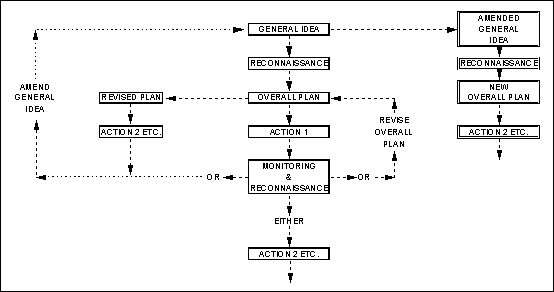
I would expect to base my research
strategy on this idealized process diagram. From the General
Idea outlined here as a basis for commencing the research, the
Reconnaissance would involve a survey of educational IT
possibilities and their current implementation, after which
the situation would be assessed and an Overall Plan for
designing and implementing an appropriate IT approach to the
problem would be formulated. At this point, simultaneous to
the development of an exemplar to suit the muslim community
situation, soundings would be taken from the education and
faith communities, and the designs revised accordingly.
Response to progress will need to be continuously monitored,
and the range of interested parties involved extended.
"Action research functions best when it is co-operative
action research. This method of research incorporates the
ideas and expectations of all persons involved in the
situation." (Hill & Kerber, 1967) The conclusion to
this phase of research would be the successful design of a
feasible system, acceptable to all, and capable of being
developed for implementation into the education system in a
subsequent research project.
"a major issue is not just to
have research done by individuals in higher education and
further educational research conducted by teachers, but
collaboration over investigations between teachers and
researcher as the next logical step on the research
agenda." (Burgess, 1985, p. 8)
Postscript
"We believe that `... to nurture
a child into a particular faith' is essential for all Muslim
children not merely because this could help in the maintenance
of religious traditions or beliefs or because it could help to
retain group identity and cohesiveness, but because an
appreciation of Islam will prepare them to contribute to a
pluralist democracy in a very positive way and with greater
confidence and self assurance." (The Council of Mosques;
UK & Eire, 1986, p. 28)
References
ed. Burgess
R.G. (1985)
Issues in Educational Research: Qualitative Methods (Falmer,
Lewes)
ed.
Cajendra, Verma K. & Bagley
C. (1982)
Self Concept, Achievement and Multicultural Education
(Macmillan Press)
Carr W. & Kemmis S. (1983)
Becoming Critical: Knowing through Action Research (Deakin
University Press, Geelong, Victoria)
Cohen L. & Manion L. (1980)
Research Methods in Education (Croom Helm, London)
The Council of Mosques; U.K. &
Eire (1986)
The Muslims and "Swann"
ed. Cummings W.K., Gopinathan S.
& Tomodo Y. (1988)
The Revival of Values Education in Asia and the West
(Pergamon Press)
Department of Education and Science
(1985)
Education for All: The Report of the Committee of Inquiry into
the Education of Children from Ethnic Minority Groups (HMSO, London)
ed. Hammerseley M. (1993)
Educational Research - Current Issues (Open University Press,
London)
ed. Halsey A.H. (1972)
Educational Priority: Volume 1: E.P.A. Problems and Policies
(HMSO, London)
Her Majesty's Inspectorate (1989)
Aspects of Primary Education: The Teaching and Learning of
Mathematics
(HMSO, London)
Hill
J.E. & Kerber A. (1967)
Models, Methods, and Analytical Procedures in Educational
Research
(Wayne State University Press, Detroit)
ed. Khan
M.W. (1981)
Education and Society in the Muslim World (Hodder
and Stoughton, Jeddah)
Lewin K. (1948)
Resolving Social Conflicts (Harper, New York)
Todd R. (1991)
Education
in a Multicultural Society (Cassell)
|